
Article content
The nation’s first bachelor's degree in quantum systems engineering has officially launched with the start of the Fall 2026 semester at Colorado School of Mines.
Early interest in the program has exceeded expectations, with more than 50 first-year Mines students declaring quantum as their majors and more than a dozen second-year students already filing the paperwork to officially switch to the new major.
“It's not just the physicists, the students who have a physics background that are interested in going into this major,” said Fred Sarazin, Ben L. Fryrear Presidential Chair and director of quantum at Mines. “We're seeing students from computer science, electrical engineering, mechanical engineering all interested in learning more about quantum tech and how this new degree pathway prepares them for careers in a growing industry in Colorado and beyond.”
More than half of today’s quantum jobs require a bachelor’s degree or less. But almost all quantum education and training programs in the U.S. are at the master’s and PhD level. The Bachelor of Science in Quantum Systems Engineering (QSE) was designed to fill that gap, informed by industry input and tailored to prepare students to move beyond theory to design, integrate, deploy and manage complete quantum-enabled systems.
Coursework integrates hardware, software and systems-level thinking skills to prepare students to build and deploy real-world quantum technologies. Students will develop core competencies in physics, data analysis, laboratory methods, electronics and embedded systems, problem solving and computing – all essential skills across quantum job sectors.
It was the degree's interdisciplinary foundation that appealed most to sophomore Thomas Glenn, one of the first students to officially switch his major to quantum systems engineering.
“When I heard about the quantum systems engineering major, I was like, what even is this? What's quantum? Can I even touch this, a little qubit inside a cryofridge?” said Glenn, who entered Mines as an electrical engineering major. “The real thing that drew me in was the classes – you span electrical engineering, computer science, mechanical engineering, physics, systems design. It gave me all the classes and skills to have a broad understanding of engineering.”
Since switching, Glenn has taken advantage of the many quantum-related events on campus and Colorado’s Front Range to learn more about quantum-enabled technology. That included a job shadow with Bifrost Electronics, a startup company founded by two Mines students to develop RF hardware for quantum computing systems headquartered at Quantum Commons in Arvada.
“This is a great time to be in the QSE major. Colorado is a quantum hub of the nation, and dozens of companies were like, hey, we want this degree, we need people with this experience,” Glenn said. “There's a lot of potential in this field. If things work out, quantum will change the world more than anything else I could major in.”
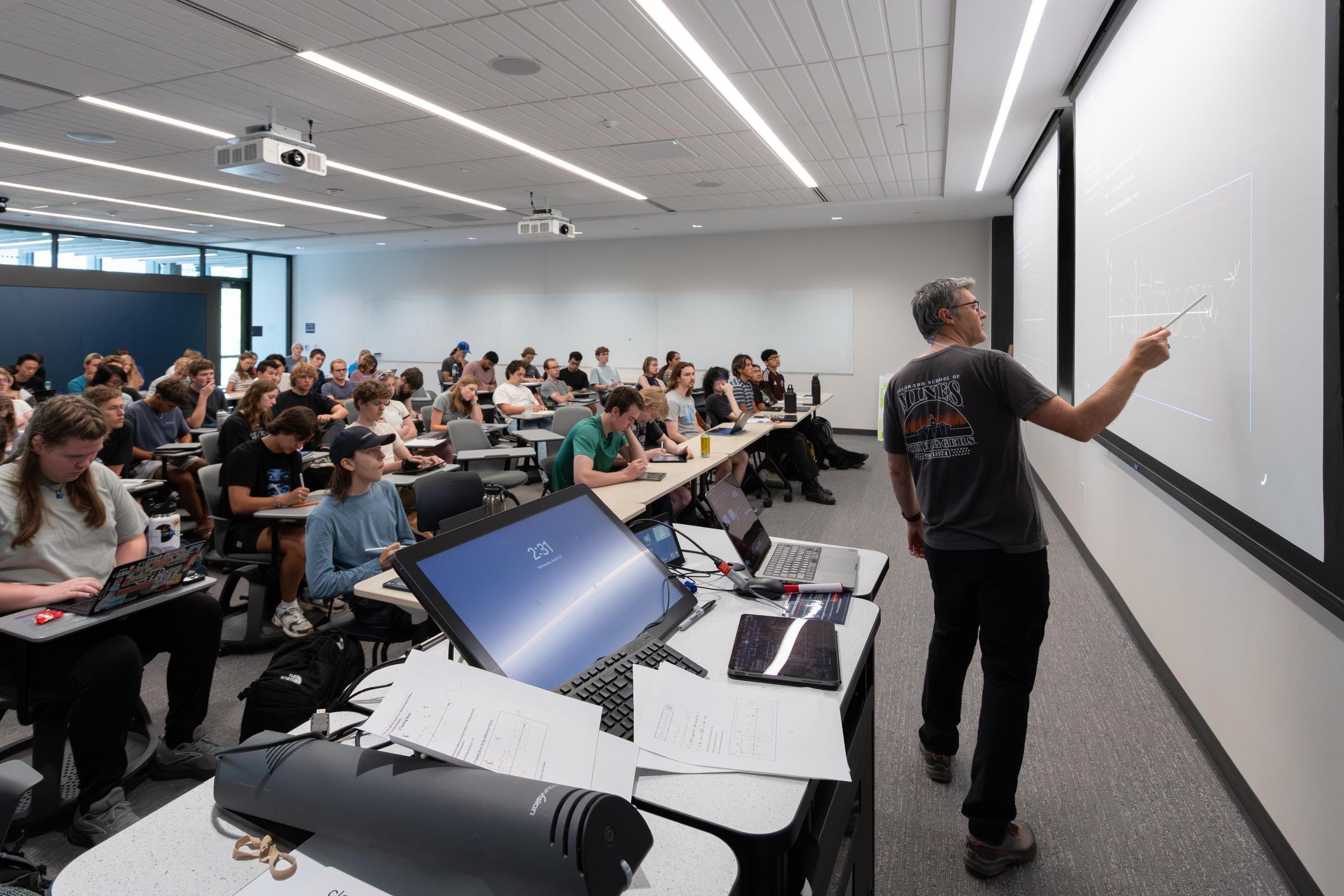
A number of Glenn's fellow Quantum Systems Engineering majors are taking their first quantum-related course this semester: Modern Physics.
The course introduces quantum mechanics and the Schrödinger equation, as well as Einstein’s special theory of relativity. In past semesters, enrollment has usually been split 50-50 between engineering physics majors, who are required to take the course during their sophomore year, and other students interested in learning more about the principles that enable all modern technology. Starting this semester, Modern Physics is now required for all quantum systems engineering majors, as well, either in the fall or spring of their sophomore year.
To further grow awareness around the program, a number of events will be held this fall, including an industry panel with Colorado quantum startups to talk about job opportunities in the industry.
Quantum companies currently employ about 3,000 people in Colorado. Elevate Quantum, a consortium of 120 organizations advancing quantum workforce development and commercialization in Colorado, New Mexico and Wyoming, estimates that number will grow to 10,000 within the next decade.
“The interest from students has been really quite amazing, especially for the incoming class,” Sarazin said. “We’re excited to build off this early momentum and give students the skills, experiences and access to facilities and industry they need to turn their interest in quantum into meaningful careers.”
/filters:format(webp)/prod01/mines/media/minesedu/admin-media/placeholder-images/Guggenheim.png)
About Mines
Colorado School of Mines is a public R1 research university focused on applied science and engineering, producing the talent, knowledge and innovations to serve industry and benefit society – all to create a more prosperous future.
.jpg)