

Faculty Directory
Steven DeCaluwe
Associate Professor, Mechanical Engineering
Director, Graduate Studies
Contact Information
Brown Hall W350E
- Advanced Energy Systems
- Materials Science
- Mechanical Engineering
- TeachPrep
Biography
Dr. Steven DeCaluwe’s research interests center on clean energy and water systems, with a focus on electrochemistry and interfacial processes. He leads the CORES Research Group, which combines fundamental experiments with numerical simulations to study the chemical, thermodynamic and fluid mechanic processes occurring at material interfaces and in reacting flows. Via fundamental insight into these processes, technologies can be designed and improved to enhance the quality of life for diverse populations and ease the impacts of human resource use on critical ecosystems and habitats across the globe.
Dr. DeCaluwe joined the Department of Mechanical Engineering in 2012 following an NRC postdoctoral fellowship at NIST in Gaithersburg, Maryland. His work at NIST used neutron scattering experiments to study solid electrolyte interphase formation in lithium-ion batteries and water uptake in thin-film polymers for PEM fuel cells.
Dr. DeCaluwe has a PhD from the University of Maryland, College Park. His dissertation was titled “Quantifying the role of ceria as catalyst in solid oxide fuel cell anodes.” His work at UMD involved electrochemical experiments, in operando physical chemistry diagnostics and multiscale simulations.
Dr. DeCaluwe holds a BS in Elementary Education and Mathematics from Peabody College at Vanderbilt University. For three years prior to attending graduate school, he taught first and second grade in Nashville, Tennessee.
Education
-
2009 - 2012 NRC postdoctoral fellowship at NIST in Gaithersburg, Maryland. My work at NIST used neutron scattering to study degradation in lithium-ion batteries and thin-film polymers for PEM fuel cells.
-
2004 - 2009 PhD, University of Maryland, College Park. Dissertation: "Quantifying the role of ceria as catalyst in solid oxide fuel cell anodes." My work at UMD involved electrochemical experiments, in operando diagnostics, and multiscale computer simulations.
-
2001 - 2004 I taught first and second grade for three years in Nashville, Tennessee, before attending graduate school.
-
1996 - 2000 Bachelor of Science, Elementary Education and Mathematics from Peabody College at Vanderbilt University.
Research
Research Areas
Our research incorporates simultaneous consideration of reacting flows, electrochemistry, and surface science to understand and improve clean energy and clean water devices. More specifically, we combine operando measurements and numerical simulations to understand:
- The influence of conductive polymer microstructure and distribution in polymer electrolyte membrane (PEM) fuel cells
- Degradation in Li-ion batteries via growth and evolution of the solid electrolyte interphase (SEI)
- The impact of novel chemistries in advanced “beyond Li-ion” batteries, including lithium-sulfur, lithium-O2, and silicon anodes
- Degradation due to mineral scaling in water desalination systems
Visit the CORES Research Group site to learn about projects, publications and group members!
My research interests center on clean energy and water systems, with a focus on electrochemistry and interfacial processes. My group's work combines experiments with numerical simulations to study the chemical, thermodynamic and fluid mechanic processes occurring at material interfaces and in reacting flows.
By learning about individual processes, we can design and improve technologies to enhance quality of life for diverse populations and ease the impacts of human activity on ecosystems and habitats across the globe.
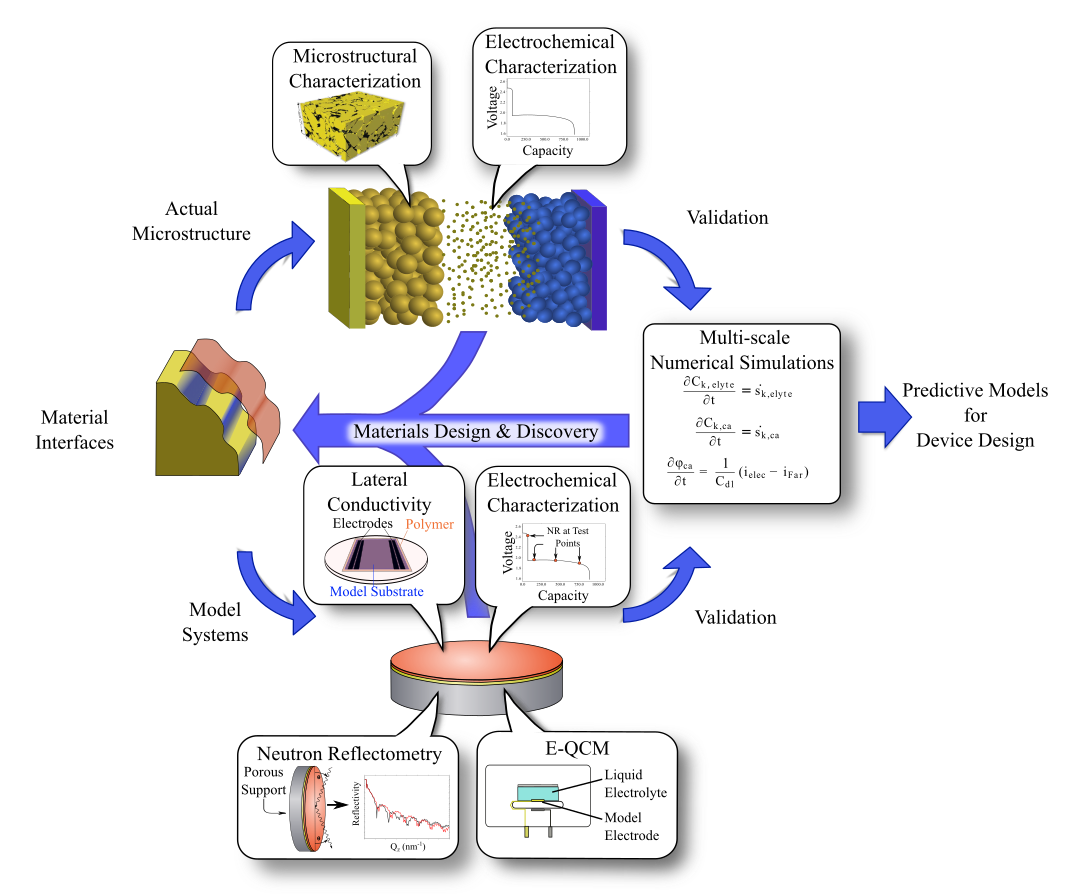
The figure below gives an overview of my research philosophy, how the different activities in my group fit together, and the iterative nature of scientific discovery and engineering design:
Labs & Research Centers
- CORES Research Group (Colorado Reacting Flows, Electrochemistry and Surface Science)
- Energy Conversion and Storage Lab
Publications
- DeCaluwe, S. C. “Open Software for Chemical and Electrochemical Modeling: Opportunities and Challenges.” ECS Interface 28(1):47–50 (2019).
- Lee, C. H., Dura, J. A., LeBar, A., DeCaluwe, S. C. “Direct, Operando Observation of the Bilayer Solid Electrolyte Interphase Structure: Electrolyte Reduction on a Non-Intercalating Electrode.” Journal of Power Sources 412:725–735 (2019).
- DeCaluwe, S. C., Weddle, P. J, Zhu, H. Y., Colclasure, A. M., Bessler, W. G., Jackson, G. S., Kee, R. J. “On the Fundamental and Practical Aspects of Modeling Complex Electrochemical Kinetics and Transport.” Journal of the Electrochemical Society 165(13):E637–E658 (2018).
- DeCaluwe, S. C., Baker, A. M., Bhargava, P., Fischer, J. E., Dura, J. A. “Structure-Property Relationships at Nafion Thin-Film Interfaces: Thickness Effects on Hydration and Anisotropic Ion Transport.” Nano Energy 46:91–100 (2018).
- Kogekar, G., Karakaya, C., Liskovich, G. J., Oehlschlaeger, M. A., DeCaluwe, S. C. Kee, R. J. “Impact of Non-Ideal Behavior on Ignition Delay and Chemical Kinetics in High-Pressure Shock Tube Reactors.” Combustion and Flame 189:1–11 (2018).
- DeCaluwe, S. C., Dhar, B. M., Huang, L., He, Y., Yang, K., Owejan, P., Zhao, Y., Talin, A. A., Dura, J. A., Wang, H. “Pore Collapse and Regrowth in Silicon Electrodes for Rechargeable Batteries.” Physical Chemistry Chemical Physics 17(17):11301–11312 (2015).
- DeCaluwe, S. C., Kienzle, P. A., Bhargava, P., Baker, A. M., Dura, J. A. “Phase Segregation of Sulfonate Groups in Nafion Interface Lamellae, Quantified via Neutron Reflectometry Fitting Techniques for Multi-Layered Structures.” Soft Matter 10(31):5763–5776 (2014).
See more in Google Scholar
Additional Information
Recent Courses
- Thermodynamics (MEGN 361)
- Fuel Cell Science Technology (MEGN 469/569)
- Electrochemical Systems Engineering (MEGN 570)
Teaching Overview
Visit the DeCaluwe Teaching page to learn more about courses taught, class activities, and other teaching and mentoring activities.
My teaching philosophy is heavily influenced by three key concepts:
- Constructivist learning theory
- Active learning techniques
- A growth-based (rather than "fixed") mindset
I believe that all students are capable of success, but that deep, permanent learning requires communication among all class participants, which allows the instructor to create engaging and meaningful learning experiences that challenge students at the appropriate level and connect prior experiences and concepts to new ideas.
In my classrooms you will see a mixture of different activities, including not just lecture but also small group work, individual problem solving, and open-ended conversations. These are designed to foster greater student engagement in the learning process, promote interaction, and provide critical, real-time feedback and insight into student understanding of course concepts and mastery of skills.
Service
One of the great gifts of working in academia is that we are given space and encouraged to help shape the communities in which we work and live. Here are some of my main service activities. Please email if you want to discuss any of them!
- Chair: Mechanical Engineering Diversity, Inclusion, and Access Committee.
- Associate Editor: ASME's Journal of Electrochemical Energy Conversion and Storage
- Organizing Committee / Local Chair: 2022 American Conference on Neutron Scattering
- Board Member: Colorado School of Mines Shared Instrumentation Facility
- Director: Colorado School of Mines Rocky Mountain Environmental XPS Facility
Engineering Values
Visit my page on Science and Engineering Values to read more about the values that shape my work. At their core, science and engineering are value-laden enterprises. As scientists and engineers, our work touches lives and impacts our environment on a very broad scope. Our work has implications for environmental sustainability, social justice, and public policy, among other spheres, and can be used to improve the lives of those around us. At the same time, poorly considered or perfunctory work that fails to fully consider its own impact can have significant negative consequences for those around us.
Three major values and themes that inspire my work are (i) Conservation Biology, (ii) Diversity, Equity and Inclusion, and (iii) Open Science. These ideas influence what work I do, how I carry it out and how that work relates to the world around me.
- Conservation biology is an interdisciplinary field devoted to preserving the Earth's biodiversity. This value provides a lens through which to interpret and apply my work. It also inspires a unique area of outreach to better connect engineers who design products with conservation biologists who can holistically evaluate their impacts.
- Making our teaching and research cultures more diverse, equitable and inclusive not only alleviates bias and inequality in our society but also improves the resulting science and engineering work and helps us better understand and communicate the impact of our work on those around us.
- Open science is an approach to improve the transparency, accessibility and reproducibility of scientific work. A more open process leads to greater collaboration, more sound science and usually greater impact. (A poignant quote from the linked source: "Articles with a preprint received higher Altmetric scores and more citations than articles without a preprint.")
Research Pillars
Energy | Fundamentals
Research Focus Areas
Advanced Energy Systems & Integration | Analytical & Computational Chemistry
Research Keywords
Advanced Fuel Cells & Electrolyzers | Computational Analysis | Electrochemical Materials & Systems | Energy Conversion | Energy Storage | Hydrogen Separation & Purification | Materials for Energy | Polymer Chemistry & Synthesis | Surface & Interface Analysis | Surface & Nano Science