

/filters:format(webp)/prod01/mines/media/minesedu/admin-media/program-pages-and-finder/program-finder-photos-/Additive-Manufacturing-Grad-MP-NT.jpg)
Additive Manufacturing (Non-Thesis)
Professional Master’s
Delivery Options
 Campus
 Online
Fall 2026 Deadline
Campus
Domestic: August 1st
International: March 1st
Online
Fall I & II (August 19 start): August 1st
Fall III (October 22nd start): October 1st
Department
Program Overview
Additive manufacturing engineers are redefining how complex parts are designed, built and delivered. They’re finding new solutions to lightweight aerospace components, medical devices, energy systems and more, enabling customization at scale, shortening supply chains and taking prototype to production.
The Professional Master’s in Additive Manufacturing (Non-Thesis) at Colorado School of Mines prepares you to harness advanced 3D printing technologies to design, optimize and produce next-generation components for the next era of manufacturing.
You’ll move up the problem-solving ladder, taking on greater responsibility and a more direct role in the technical decisions that shape product performance and production strategy. With hands-on experience with powder bed fusion, directed energy deposition, binder jetting and polymer printing, you’ll graduate with in-demand expertise in process optimization, material behavior and part qualification.
With a Professional Master’s in Additive Manufacturing from Mines, you’ll be ready to advance your career with in-demand skills that are challenging, valued and impactful.
Program Detail
In the Professional Master’s of Additive Manufacturing (Non-Thesis), you will complete 30 credits of graduate-level coursework with the option to apply up to six credits toward an applied analytical or professional report. The program is designed for students seeking professional practice or technical leadership roles rather than academic research careers.
Students are expected to have undergraduate preparation comparable to a degree in mechanical engineering, materials science, aerospace engineering, manufacturing engineering or a closely related field with strong foundations in materials and design
Core coursework emphasizes AM processes, design for additive manufacturing (DfAM), material behavior, process control and quality assurance with electives that allow you to tailor the degree toward metals, polymers, ceramics or application-specific manufacturing. An optional professional report enables deeper engagement with applied problems, industry-sponsored projects or process qualification studies.
While in residence, students enroll in graduate seminars and colloquia that connect coursework to professional practice, current research and industry applications.
Areas of Specialization
The Professional Master’s of Additive Manufacturing allows you to align your graduate training with the manufacturing challenges you want to address.
Metal Additive Manufacturing and Process Control
Prepare for roles focused on laser powder bed fusion (L-PBF), electron beam melting (EBM), directed energy deposition (DED), process parameter optimization and defect mitigation using advanced metal AM technologies.
Design for Additive Manufacturing and Topology Optimization
Develop expertise in generative design, lattice structures, multi-material design, support structure optimization and data-driven approaches to exploiting AM design freedom.
Materials Development and Qualification
Prepare for careers supporting new alloy development, material characterization, mechanical testing, microstructure analysis and certification pathways for AM materials through applied materials science.
Faculty Expertise
/filters:format(webp)/prod01/mines/media/minesedu/faculty-headshots/brice-craig.jpg)
/filters:format(webp)/prod01/mines/media/minesedu/faculty-headshots/gockel-joy.jpeg)
/filters:format(webp)/prod01/mines/media/minesedu/faculty-headshots/webster-samantha.webp)
Application Requirements
-
Bachelor's degree
-
GRE: Not Required
-
Letters of Recommendations (2 letters).
Letters are not required for current Mines students. -
Resume or Curriculum Vitae (CV)
-
Statement of Purpose
-
Transcripts
-
International students please review the English proficiency requirements
Program Curriculum
View Academic CatalogWorld-Class Labs, Centers & Facilities
Additive manufacturing students gain practical expertise and skills with tools and facilities across the additive manufacturing workflow, from concept and design through fabrication, testing and qualification.
/filters:format(webp)/29x0:2572x1733/prod01/mines/media/minesedu/admin-media/facilities/ADAPT-Lab.jpg)
The Alliance for the Development of Additive Processing Technologies (ADAPT) is a research center and industry consortium that brings a multidisciplinary lens to additive manufacturing challenges. Led by Professor of Practice Craig Brice, ADAPT’s focus includes materials development and characterization, processing-structure-property relationships, process control and part qualification and data informatics
/filters:format(webp)/31x0:2570x1730/prod01/mines/media/minesedu/admin-media/facilities/Shared-Instrumentation-Facility.jpg)
The Mines Shared Instrumentation Facility (SIF) provides centralized access to world-class scientific equipment and engineering instruments on the Mines campus, including electron microscopy, mass spectrometry, materials manufacturing, mechanical testing, nanofabrication, optical and electrical surface characterization, scanning probe and optical microscopy, thin film deposition, water quality analysis, x-ray diffraction and photoelectron spectroscopy.
/filters:format(webp)/28x0:2572x1734/prod01/mines/media/minesedu/admin-media/facilities/Labriola-Innovation-Hub.jpg)
The Labriola Innovation Hub – or InnoHub for short – provides a dynamic environment that combines hands-on education, project support, access to tools and collaboration space where students can try new things, regardless of experience level or motivation
Salary Outlook
Average starting salary for recent program graduates is $97,900. Learn more about Mines' comprehensive career development resources and this degree's salary potential.
Employers who seek Mines graduates include:
Aerospace & Defense
Companies such as Lockheed Martin, Northrop Grumman, The Boeing Company, Ball Aerospace (now BAE Systems Space & Mission Systems), Sierra Space, Raytheon Technologies (RTX), SpaceX, Blue Origin
Energy & Industrial Manufacturing
Companies such as Baker Hughes, Halliburton, Siemens Energy, General Electric (GE Aerospace / GE Vernova), Caterpillar Inc., Faurecia
Additive Manufacturing Technology & Specialized Services
Companies such as 3D Systems, Stratasys, Velo3D, Elementum 3D, Carpenter Additive, Faustson Tool
Government & Research Institutions
Companies such as National Laboratory of the Rockies (NLR), Los Alamos National Laboratory, Sandia National Laboratories, NASA (Johnson Space Center / Marshall Space Flight Center)
/filters:format(webp)/prod01/mines/media/minesedu/admin-media/stock-photos/Aerospace-and-Defense.jpg)
Frequently Asked Questions
What is the value of a graduate degree in Additive Manufacturing?
A graduate degree in additive manufacturing equips you to design, optimize and qualify parts produced through 3D printing technologies that are transforming aerospace, medical, energy and manufacturing industries. At Colorado School of Mines, additive manufacturing is taught as an applied, multidisciplinary field that connects materials science, mechanical design, process engineering and quality systems. Graduates leave prepared to implement AM technologies, qualify new materials and processes, optimize production workflows and contribute immediately in professional roles across manufacturing companies, aerospace firms, medical device companies and service bureaus.
What advances are shaping the field of Additive Manufacturing?
Additive manufacturing is evolving rapidly as new processes, materials and digital tools expand production capabilities. Key advances include:
- Multi-material and functionally graded additive manufacturing for complex material distributions
- In-situ process monitoring and closed-loop control using cameras, thermal sensors and real-time feedback
- Machine learning and AI for defect prediction, parameter optimization and quality assurance
- Large-scale metal AM for aerospace structures, tooling and infrastructure components
- High-throughput polymer AM and automated post-processing for mass customization
- Digital thread integration connecting design, simulation, manufacturing and inspection data
What career options will I have with a degree in Additive Manufacturing?
Graduates pursue technical and engineering roles that require AM expertise and manufacturing knowledge including:
- Additive manufacturing engineer or process engineer
- Design for additive manufacturing (DfAM) specialist
- Materials engineer focused on AM alloys and materials
- Quality engineer or certification specialist for AM parts
- Production engineer implementing AM in manufacturing
- Applications engineer for AM equipment manufacturers
- R&D engineer developing new AM processes or materials
- Manufacturing technology consultant
- Technical sales engineer for AM systems and materials
- Research scientist in advanced manufacturing laboratories
What are current research areas within the field of Additive Manufacturing?
- Current research in additive manufacturing spans both academic and industry settings with a shared focus on improving performance, reliability, scalability and qualification while expanding the range of materials and applications. Key research areas include:
- Process–structure–property relationships examining how process parameters influence microstructure, mechanical performance and long-term reliability
- In-situ monitoring and sensor integration using thermal imaging, optical systems and data capture to detect defects and enable closed-loop process control
- Data-driven modeling, machine learning and AI applied to parameter optimization, defect prediction and quality assurance
- Design for Additive Manufacturing (DfAM) including topology optimization, lattice structures and geometry-enabled performance improvements
- Material development and qualification focusing on new metal alloys, high-performance polymers, composites, ceramics and bio-compatible materials
- Multi-material and functionally graded structures enabling tailored material properties within a single component
- Part qualification, certification and standards development supporting adoption in regulated industries such as aerospace, energy and medical devices
- Large-format and high-rate additive manufacturing addressing scalability, build speed and cost for production applications
- Post-processing and hybrid manufacturing integrating heat treatment, machining and surface finishing into AM workflows
- Digital thread and digital twin integration connecting design, simulation, manufacturing, inspection and lifecycle data
- Supply chain resilience and distributed manufacturing exploring how AM can reduce lead times, tooling requirements and logistical risk
In academic settings, these research efforts advance fundamental understanding of materials, processes and mechanics. In industry, they are applied to production readiness, certification, cost reduction and workforce adoption. Together, this work is driving the transition of additive manufacturing from prototyping toward robust, repeatable, production-scale deployment across aerospace, energy, medical and advanced manufacturing sectors.
Featured Alumni
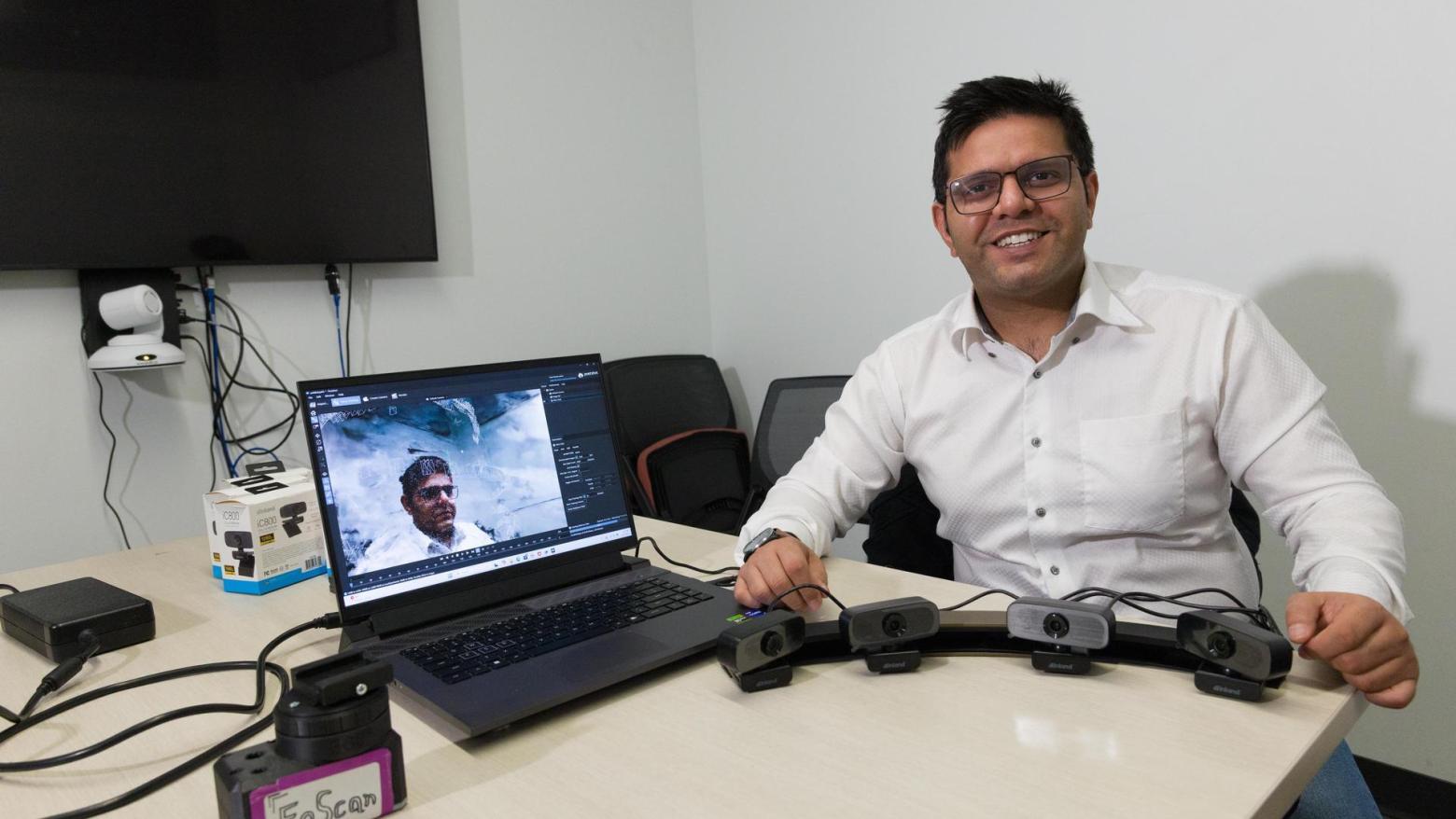

Meet Navdeep Bhusri, Additive Manufacturing
Labriola is one of the best spaces that Mines has. I did my dental and postgraduate training in five different universities all over the world, but I haven’t found any space as comprehensive as Labriola that connects the whole campus together. It brings people from all the departments and backgrounds together and it’s just so wonderful to work there.
/filters:format(webp)/prod01/mines/media/minesedu/admin-media/program-pages-and-finder/program-finder-photos-/Materials-Science-Grad-MS-NT.jpg)
/filters:format(webp)/prod01/mines/media/minesedu/admin-media/program-pages-and-finder/program-finder-photos-/Mechanical-Engineering-Grad-MS-NT.jpg)
/filters:format(webp)/prod01/mines/media/minesedu/admin-media/program-pages-and-finder/program-finder-photos-/Operations-Research-with-Engineering-Grad-MS-NT.jpg)
/prod01/mines/media/minesedu/newsroom/images/ProtoFund-Face-Scanning-System-251202-005-TM-(1).jpg)
/prod01/mines/media/minesedu/newsroom/images/guam_photo.jpg)